Loading...
Serving Ventura, CA and surrounding areas. (805) 833-5370
Your foundation is the one thing under your home you cannot afford to get wrong. We install concrete foundations in Ventura built for fault-zone seismic code, coastal clay soils, and city permit requirements.
Foundation installation in Ventura covers the full scope from excavation to final city inspection - most residential projects take one to three weeks of active construction, plus several weeks for permit approval and concrete curing before framing can begin.
Whether you are building a new home, adding a room, or replacing a foundation that has reached the end of its useful life, the process in Ventura starts with a permit. The City of Ventura Building and Safety Division reviews the structural plans and inspects the work at multiple stages. That inspection process is your best protection - it means someone independent of your contractor confirms the work was done correctly before it gets buried and built upon.
For smaller new-build projects like detached garages or ADUs, our slab foundation building service covers that scope specifically, with the same permit process and seismic detailing built in.
If doors or windows in your home have started sticking, jamming, or leaving visible gaps at the corners, the frame of your house may be shifting. This is one of the earliest signs that something is moving underneath. In Ventura, this symptom often appears after a wet winter when expansive clay soils have absorbed moisture and pushed against the foundation from below.
Hairline cracks in drywall are common and usually harmless, but diagonal cracks running from the corners of windows or doors, or cracks wider than a quarter inch, suggest the foundation is moving unevenly. Cracks in tile floors that follow the grout lines are another signal worth taking seriously - especially in a Ventura home built before 1980.
If a ball placed on your floor rolls consistently in one direction, your floors may have developed a slope over time. This can happen gradually and is easy to miss until it becomes pronounced. In Ventura's hillside neighborhoods, this is sometimes caused by soil movement on sloped lots rather than foundation failure - but either way, it needs a professional evaluation.
Standing water, persistent dampness, or a musty odor coming from under your home after rain may mean your foundation is not draining or sealing properly. Ventura's rainy season - November through March - regularly exposes drainage problems that stay hidden in dry months. Left unaddressed, moisture intrusion can weaken concrete and corrode the steel reinforcement inside it.
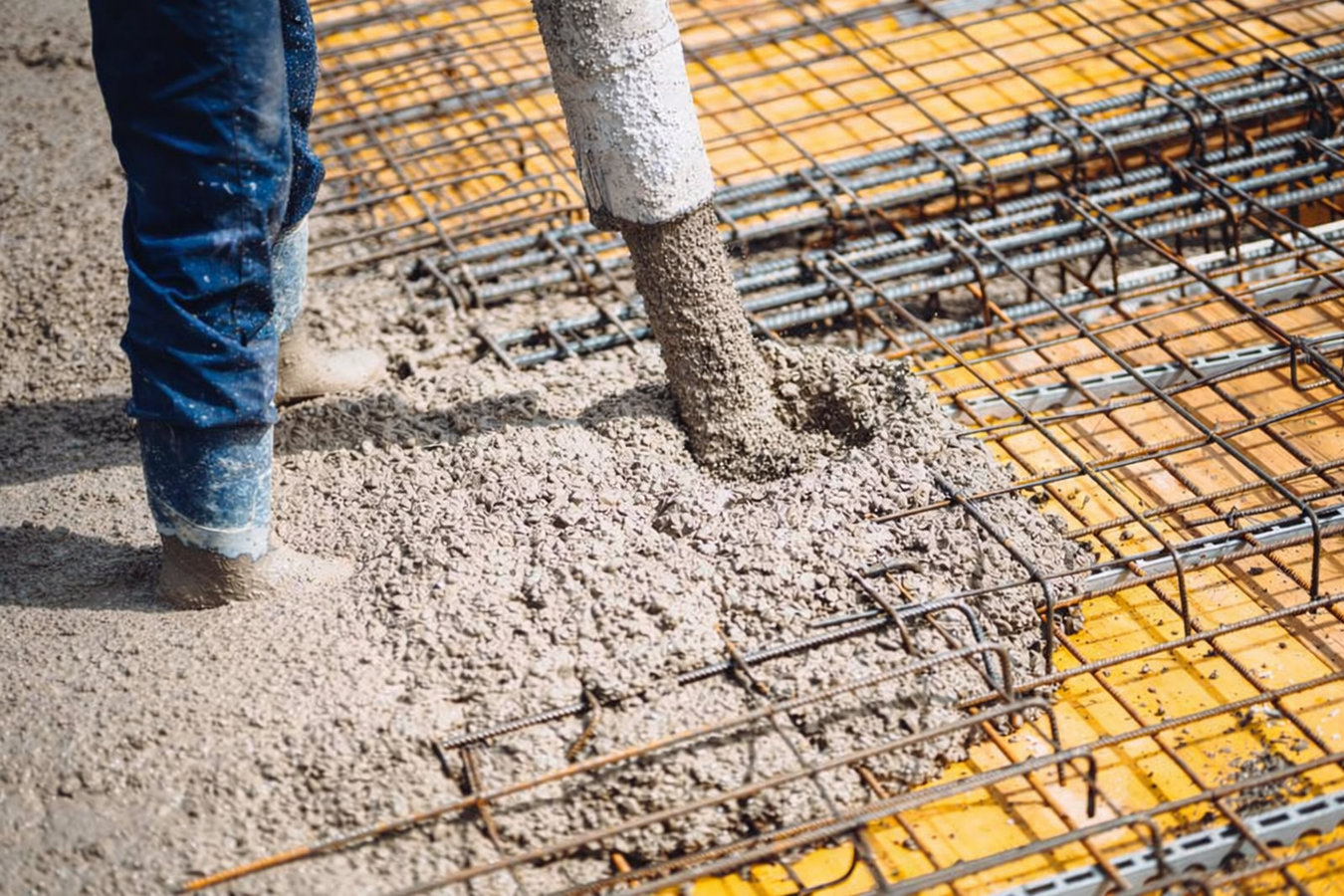
Every foundation project starts with a site visit and, where warranted, a soil investigation to understand what is actually in the ground before we design anything. From there we manage the full scope: excavation, forming, steel reinforcement, the concrete pour, curing, and final city inspection. Permits are handled by us - we submit to the City of Ventura Building and Safety Division and coordinate inspection scheduling so your project keeps moving. For projects that also require a standalone slab component, our slab foundation building service can be scoped alongside the foundation work in a single coordinated project.
When a foundation project involves a commercial or larger multi-use structure, our concrete parking lot building service can handle the flatwork scope for the surrounding site - keeping grades, drainage, and surface finishes consistent across the entire project footprint.
For builders and homeowners constructing a new single-family home or multi-unit structure on a lot requiring full excavation and foundation from the ground up.
For pre-1980 Ventura homes where the original foundation predates current seismic requirements and has deteriorated or shifted beyond repair.
For homeowners adding a room addition or accessory dwelling unit that requires a new separate or attached foundation element.
For properties where a slab-on-grade is not suitable and the structural design calls for a raised perimeter foundation with a crawl space below.
For any project in Ventura County where local building code requires a structural engineer to design for lateral seismic loads - which applies to all residential foundations here.
For every project requiring City of Ventura permits and multi-stage inspections - we manage the paperwork and provide you with the signed inspection records at closeout.
Ventura County sits near the San Andreas and Ventura fault systems, placing it in one of the most seismically active parts of the United States. This is not background noise - it directly shapes every design decision in a foundation project, from how deep footings must go to how the steel is placed and anchored. The Portland Cement Association and the American Concrete Institute both publish standards for seismic foundation detailing - the local code is built on top of those standards and adds Ventura-specific requirements on top. A contractor who does not work regularly in this region will often underestimate what is actually required.
Parts of Ventura also have clay-heavy soils that expand when wet and contract when dry - a cycle that puts stress on any foundation not designed with that movement in mind. Older neighborhoods near downtown and in the Westside are particularly affected. We serve properties across the region, including homes in Santa Paula and communities in Oxnard, where soil conditions and lot characteristics vary enough that a site visit is always the first step before any quote.
We schedule a visit - typically within one business day of your call - to look at your lot, soil conditions, and access before writing a number. Foundation quotes without a site visit are rarely accurate in Ventura, where lot conditions vary significantly from block to block.
Where required, we coordinate a structural engineer to design the foundation and submit permit plans to the City of Ventura. If a soil test has not been done, this is when it happens. Permit approval typically takes a few weeks to two months depending on project complexity.
Once the permit is approved, we mark the foundation area and begin excavating. This is the noisiest phase - heavy equipment and removed soil need room to work. We will let you and your neighbors know in advance what to expect so there are no surprises.
The crew sets forms, places rebar, and pours the concrete - usually in a single workday for a standard residential foundation. A city inspector visits at least once during curing. When the foundation passes inspection and is fully cured, we walk you through the finished work and hand you the signed inspection records.
Free on-site estimate. We handle permits, engineering coordination, and city inspection. No commitment required.
(805) 833-5370Ventura County's proximity to the San Andreas and Ventura fault systems puts it in one of California's highest seismic hazard categories. Every foundation we install is designed and detailed for that specific risk - not adapted from a template built for a lower-risk market.
We serve all 12 communities in our service area, from coastal Ventura to Santa Paula and Oxnard. That range means we understand how soil conditions, drainage, and lot constraints vary across this region - and we apply the same structural standard regardless of which city your property is in.
A significant portion of Ventura's housing stock was built before the 1980s, before current seismic foundation standards were in place. Replacing or retrofitting a foundation on one of these homes requires experience with what older construction actually looks like once opened up. We have worked on mid-century Ventura homes across multiple neighborhoods.
The City of Ventura's permit review process requires specific documentation that can cause delays when submitted incorrectly. We work with the local Building and Safety Division regularly and submit complete applications the first time - which keeps your project on the schedule we quoted rather than waiting on a resubmission.
A foundation is the part of your home no one sees - which is why everything about how it is built has to be documented and inspected before it disappears underground. Every project we complete comes with a full set of signed inspection records for your files.
Concrete flatwork for parking areas and surrounding site surfaces, designed to match the grades and drainage of an adjacent foundation project.
Learn moreStandalone slab pours for detached garages, ADUs, and room additions where a full foundation replacement is not required but a new permitted slab is.
Learn morePermit timelines fill up fast - reaching out now means your project gets scheduled ahead of the backlog and stays on track through inspection.